Definition 1 (Hyperbelfunktionen)[Bearbeiten]
- Für alle
 erklären wir den Cosinus hyperbolicus durch

,
- den Sinus hyperbolicus durch

,
- den Tangens hyperbolicus durch

- und den Cotangens hyperbolicus durch

- Die Hyperbelfunktionen sind in
 stetig differenzierbar und es gelten für die folgenden Differentiationsregeln:
(1)
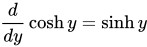 und
und 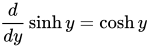
(1)
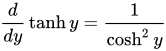 und
und 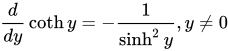 .
.Wir beachten die obige Definition der Hyperbelfunktionen durch die trigonometrischen Funktionen. Von den ersten beiden Differentiationsregeln berechnen wir
(2)

.
Unter Verwendung von Satz 9 aus §2 ermitteln wir die dritte Differentiationsregel:
(3)

.
Satz 2 (Additionstheorem für die Hyperbelfunktionen)[Bearbeiten]
- Für alle
 gelten die folgenden Identitäten:
(4)

- Des Weiteren gilt für alle die Identität
(5)

.
Mit dem Additionstheorem berechnen wir von (4) die erste Gleichung:
(6)


![{\displaystyle =\cos(iy_{1})\cdot \cos(iy_{2})+[-i\cdot \sin(iy_{1})]\cdot [-i\cdot \sin(iy_{2})]}](https://wikimedia.org/api/rest_v1/media/math/render/svg/ee30dc405b5cb4b4f6c70d72c752c51b09605a7b)

für alle
.
Weiter ermitteln wir für alle :
(7)

.
q.e.d.
- Die ungerade Funktion
 vermöge
  ist in streng monoton steigend und wir haben das asymptotische Verhalten

.
Wegen der Ungleichung

ist die Funktion Sinus hyperbolicus auf streng monoton steigend. Weiter ist  eine gerade Funktion, da dieses auch für
  zutrifft und es gilt
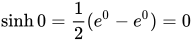
.
Gemäß §1 ist 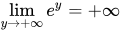 und
und 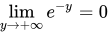 erfüllt und wir erhalten

.
Aus der Eigenschaft  folgen nun alle weiteren Aussagen.
q.e.d.
- Die ungerade Funktion
 vermöge
  ist im Intervall
  streng monoton steigend und es gilt
 sowie
sowie  .
.Wegen  für alle
  ist die Funktion Cosinus hyperbolicus im Intervall
  streng monoton steigend. Weiter gilt
 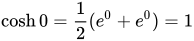 . Da die Cosinusfunktion gerade ist, folgt

.
Wegen der asymptotischen Eigenschaften der Exponentialfunktion ist die Bedingung

erfüllt. Schließlich folgt noch  , denn
  ist eine gerade Funktion.
q.e.d.
- Die Gesamtheit der reellen Stammfunktionen vom Cosinus hyperbolicus bzw. vom Sinus hyperbolicus sind gegeben durch
(8)
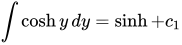 und
und 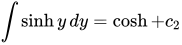
- mit den reellen Integrationskonstanten

- Für den Tangens hyperbolicus gilt
(9)

- mit der reellen Integrationskonstante
 .
.

