Let  denote a two-dimensional normal local noetherian domain and let
 and
and  be two parameters in
  . On
. On
 we have the short exact sequence
-

and its corresponding long exact sequence of cohomology,
-

The connecting homomorphism  sends an element
 to
to  . The torsor given by such a cohomology class
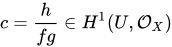 can be realized by the forcing algebra
-
![{\displaystyle R[T_{1},T_{2}]/{\left(fT_{1}+gT_{2}-h\right)}.}](https://wikimedia.org/api/rest_v1/media/math/render/svg/ee69e1f9857228f31ca2f3e8a27e0de03c56819f)
Note that different forcing algebras may give the same torsor, because the torsor depends only on the spectrum of the forcing algebra restricted to the punctured spectrum of . For example, the cohomology class
 defines one torsor, but the two fractions yield the two forcing algebras
![{\displaystyle {}R[T_{1},T_{2}]/{\left(fT_{1}+gT_{2}-1\right)}}](https://wikimedia.org/api/rest_v1/media/math/render/svg/e28856cec359ce14a43ac247b455b06b4903044e) and
and ![{\displaystyle {}R[T_{1},T_{2}]/{\left(f^{2}T_{1}+g^{2}T_{2}-fg\right)}}](https://wikimedia.org/api/rest_v1/media/math/render/svg/3aa401d37f4f5572cd4a133307fb46c0ea495f52) ,
which are quite different. The fiber over the maximal ideal of the first one is empty, whereas the fiber over the maximal ideal of the second one is a plane.
,
which are quite different. The fiber over the maximal ideal of the first one is empty, whereas the fiber over the maximal ideal of the second one is a plane.
If is regular, say
![{\displaystyle {}R=K[X,Y]}](https://wikimedia.org/api/rest_v1/media/math/render/svg/741a7312a72cfa1318f1fcc9106f3da7e7274db0) (or the localization of this at
(or the localization of this at  or the corresponding power series ring)
then the first cohomology classes are
or the corresponding power series ring)
then the first cohomology classes are  -linear combinations of
 ,
,  .
.
They are realized by the forcing algebras
-
![{\displaystyle K[X,Y,T_{1},T_{2}]/{\left(X^{i}T_{1}+Y^{j}T_{2}-1\right)}.}](https://wikimedia.org/api/rest_v1/media/math/render/svg/9285b97981410aba8d2227935f958b54c6f6cc4d)
Since the fiber over the maximal ideal is empty, the spectrum of the forcing algebra equals the torsor. Or, the other way round, the torsor is itself an affine scheme.

