

Vektorbündel/Torsor/Kohomologische Klassifikation/Einführung/Textabschnitt
We have seen that
![{\displaystyle {}V=\operatorname {Spec} {\left(R[T_{1},\ldots ,T_{n}]/{\left(f_{1}T_{1}+\cdots +f_{n}T_{n}\right)}\right)}\,}](https://wikimedia.org/api/rest_v1/media/math/render/svg/d7d47034f7b1b29606f347c305feef90b780de19)
acts on the spectrum of a forcing algebra by addition. The restriction of to is a vector bundle, and restricted to becomes a -torsor.
![{\displaystyle {}T=\operatorname {Spec} {\left(R[T_{1},\ldots ,T_{n}]/{\left(f_{1}T_{1}+\cdots +f_{n}T_{n}+f\right)}\right)}}](https://wikimedia.org/api/rest_v1/media/math/render/svg/ef32a29237509927be7d0e94d343b865d26f2b55)




Definition
Let denote a geometric vector bundle over a scheme . A scheme together with an action



is called a geometric (Zariski)-torsor for (or a -principal fiber bundle or a principal homogeneous space) if there exists an open covering and isomorphisms


such that the diagrams (we set and )


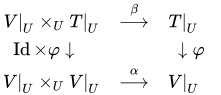
commute, where is the addition on the vector bundle.

The torsors of vector bundles can be classified in the following way.
Proposition
Let denote a noetherian separated scheme and let

denote a geometric vector bundle on with sheaf of sections .

Then there exists a correspondence between first cohomology classes and geometric -torsors.

Proof
We describe only the correspondence. Let denote a -torsor. Then there exists by definition an open covering such that there exist isomorphisms
which are compatible with the action of on itself. The isomorphisms induce automorphisms



These automorphisms are compatible with the action of on itself, and this means that they are of the form

with suitable sections
.
This family defines a Čech cocycle for the covering and gives therefore a cohomology class in .
For the reverse direction, suppose that the cohomology class
is represented by a Čech cocycle
for an open covering
.
Set
.
We take the morphisms




given by to glue the together to a scheme over . This is possible since the cocycle condition guarantees the glueing condition for schemes.


The action of
on itself glues also together to give an action on .


It follows immediately that for an affine scheme
(i.e. a scheme of type )
there is no non-trivial torsor for any vector bundle. There will however be in general many non-trivial torsors on the punctured spectrum
(and on a projective variety).
