Definiere die folgenden
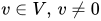
(kursiv gedruckten) Begriffe.
Die Hintereinanderschaltung der Abbildungen
F
:
L
⟶
M
{\displaystyle F\colon L\longrightarrow M}
und
G
:
M
⟶
N
.
{\displaystyle G\colon M\longrightarrow N.}
Die
Matrizenmultiplikation .
Der von einer Familie von Vektoren
v
i
,
i
∈
I
{\displaystyle {}v_{i},\,i\in I}
, aus einem
K
{\displaystyle {}K}
-
Vektorraum
V
{\displaystyle {}V}
aufgespannte Untervektorraum .
Die
Elementarmatrizen .
Ein Gruppenhomomorphismus zwischen
Gruppen
(
G
,
∘
,
e
G
)
{\displaystyle {}(G,\circ ,e_{G})}
und
(
H
,
∘
,
e
H
)
{\displaystyle {}(H,\circ ,e_{H})}
.
Ein
affiner Raum
über einem
K
{\displaystyle {}K}
-
Vektorraum
V
{\displaystyle {}V}
.
Lösung
Die Abbildung
G
∘
F
:
L
⟶
N
,
x
⟼
G
(
F
(
x
)
)
,
{\displaystyle G\circ F\colon L\longrightarrow N,\,x\longmapsto G(F(x)),}
heißt die Hintereinanderschaltung der Abbildungen
F
{\displaystyle {}F}
und
G
{\displaystyle {}G}
.
Es sei
K
{\displaystyle {}K}
ein
Körper und es sei
A
{\displaystyle {}A}
eine
m
×
n
{\displaystyle {}m\times n}
-
Matrix
und
B
{\displaystyle {}B}
eine
n
×
p
{\displaystyle {}n\times p}
-Matrix über
K
{\displaystyle {}K}
. Dann ist das Matrixprodukt
A
B
{\displaystyle AB}
diejenige
m
×
p
{\displaystyle {}m\times p}
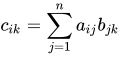
-Matrix, deren Einträge durch
c
i
k
=
∑
j
=
1
n
a
i
j
b
j
k
{\displaystyle {}c_{ik}=\sum _{j=1}^{n}a_{ij}b_{jk}\,}
gegeben sind.
Man nennt
⟨
v
i
,
i
∈
I
⟩
=
{
∑
i
∈
J
s
i
v
i
∣
s
i
∈
K
,
J
⊆
I
endliche Teilmenge
}
{\displaystyle {}\langle v_{i},\,i\in I\rangle ={\left\{\sum _{i\in J}s_{i}v_{i}\mid s_{i}\in K,\,J\subseteq I{\text{ endliche Teilmenge}}\right\}}\,}
den von der Familie aufgespannten Untervektorraum .
Mit
B
i
j
{\displaystyle {}B_{ij}}
bezeichnen wir diejenige
n
×
n
{\displaystyle {}n\times n}
-
Matrix ,
die an der Stelle
(
i
,
j
)
{\displaystyle {}(i,j)}
den Wert
1
{\displaystyle {}1}
und sonst überall den Wert null hat. Dann nennt man die folgenden Matrizen Elementarmatrizen .
V
i
j
:=
E
n
−
B
i
i
−
B
j
j
+
B
i
j
+
B
j
i
{\displaystyle {}V_{ij}:=E_{n}-B_{ii}-B_{jj}+B_{ij}+B_{ji}}
.
S
k
(
s
)
:=
E
n
+
(
s
−
1
)
B
k
k
für
s
≠
0
{\displaystyle {}S_{k}(s):=E_{n}+(s-1)B_{kk}{\text{ für }}s\neq 0}
.
A
i
j
(
a
)
:=
E
n
+
a
B
i
j
für
i
≠
j
und
a
∈
K
{\displaystyle {}A_{ij}(a):=E_{n}+aB_{ij}{\text{ für }}i\neq j{\text{ und }}a\in K}
.
Eine
Abbildung
ψ
:
G
⟶
H
{\displaystyle \psi \colon G\longrightarrow H}
heißt Gruppenhomomorphismus , wenn die Gleichheit
ψ
(
g
∘
g
′
)
=
ψ
(
g
)
∘
ψ
(
g
′
)
{\displaystyle {}\psi (g\circ g')=\psi (g)\circ \psi (g')\,}
für alle
g
,
g
′
∈
G
{\displaystyle {}g,g'\in G}
gilt.
Ein
affiner Raum
über einem
K
{\displaystyle {}K}
-
Vektorraum
V
{\displaystyle {}V}
ist
(die leere Menge oder)
eine nichtleere Menge
E
{\displaystyle {}E}
zusammen mit einer Abbildung
V
×
E
⟶
E
,
(
v
,
P
)
⟼
P
+
v
,
{\displaystyle V\times E\longrightarrow E,\,(v,P)\longmapsto P+v,}
die den drei Bedingungen
P
+
0
=
P
{\displaystyle {}P+0=P}
für alle
P
∈
E
{\displaystyle {}P\in E}
,
(
P
+
v
)
+
w
=
P
+
(
v
+
w
)
{\displaystyle {}(P+v)+w=P+(v+w)}
für alle
v
,
w
∈
V
{\displaystyle {}v,w\in V}
und
P
∈
E
{\displaystyle {}P\in E}
,
Zu je zwei Punkten
P
,
Q
∈
E
{\displaystyle {}P,Q\in E}
gibt es genau einen Vektor
v
∈
V
{\displaystyle {}v\in V}
mit
Q
=
P
+
v
{\displaystyle {}Q=P+v}
,
genügt.
Lösung
Es sei
K
{\displaystyle {}K}
ein Körper und
V
{\displaystyle {}V}
ein
K
{\displaystyle {}K}
-Vektorraum. Es sei
v
1
,
…
,
v
n
∈
V
{\displaystyle {}v_{1},\ldots ,v_{n}\in V}
eine Familie von Vektoren. Dann sind folgende Aussagen äquivalent.
Die Familie ist eine Basis von
V
{\displaystyle {}V}
.
Die Familie ist ein minimales Erzeugendensystem, d.h. sobald man einen Vektor
v
i
{\displaystyle {}v_{i}}
weglässt, liegt kein Erzeugendensystem mehr vor.
Für jeden Vektor
u
∈
V
{\displaystyle {}u\in V}
gibt es genau eine Darstellung
u
=
s
1
v
1
+
⋯
+
s
n
v
n
.
{\displaystyle u=s_{1}v_{1}+\cdots +s_{n}v_{n}.}
Die Familie ist maximal linear unabhängig, d.h. sobald man irgendeinen Vektor dazunimmt, ist die Familie nicht mehr linear unabhängig.
Es sei
K
{\displaystyle {}K}
ein
Körper ,
V
{\displaystyle {}V}
ein
K
{\displaystyle {}K}
-
Vektorraum
und
φ
:
V
⟶
V
{\displaystyle \varphi \colon V\longrightarrow V}
eine
lineare Abbildung . Es seien
v
1
,
…
,
v
n
{\displaystyle {}v_{1},\ldots ,v_{n}}
Eigenvektoren zu
(paarweise) verschiedenen
Eigenwerten
λ
1
,
…
,
λ
n
∈
K
{\displaystyle {}\lambda _{1},\ldots ,\lambda _{n}\in K}
.
Dann sind
v
1
,
…
,
v
n
{\displaystyle {}v_{1},\ldots ,v_{n}}
linear unabhängig .
Es sei
K
{\displaystyle {}K}
ein
Körper
und seien
P
1
,
…
,
P
n
{\displaystyle {}P_{1},\ldots ,P_{n}}
Polynome
über
K
{\displaystyle {}K}
. Es sei
G
{\displaystyle {}G}
ein
größter gemeinsamer Teiler
der
P
i
{\displaystyle {}P_{i}}
. Dann gibt es eine Darstellung
G
=
Q
1
P
1
+
⋯
+
Q
n
P
n
{\displaystyle {}G=Q_{1}P_{1}+\cdots +Q_{n}P_{n}\,}
mit
Q
1
,
…
,
Q
n
∈
K
[
X
]
{\displaystyle {}Q_{1},\ldots ,Q_{n}\in K[X]}
.
Erläutere das Prinzip Beweis durch Widerspruch .
Lösung
Was bedeutet das Wort „linear“ in der Linearen Algebra?
Lösung erstellen
In einer Schulklasse gibt es
32
{\displaystyle {}32}
Kinder; es wurden vier identische Pizzen bestellt, die gerecht auf die Kinder verteilt werden sollen. Es steht ein beliebig langes Messer zur Verfügung. Zeige, dass man durch

10
{\displaystyle {}10}
Schnitte die Aufteilung erreichen kann
(die Pizzen dürfen nicht übereinander gelegt werden, und die Pizzen dürfen im gesamten Schneidevorgang nicht bewegt werden).
Lösung erstellen
Professor Knopfloch fliegt von Tokio nach Frankfurt. Die Zeitdifferenz zwischen Frankfurt und Tokio beträgt 9 Stunden (wenn es in Frankfurt 12:00 ist, so ist es in Tokio bereits 21:00 am gleichen Tag). Das Flugzeug startet am Samstag um 11:30 Ortszeit in Tokio und landet am Samstag um 16:30 Ortszeit in Frankfurt und folgt dabei der eingezeichneten blauen Kurve. Die Erde ist in 24 Zeitzonen eingeteilt; in der Karte sind das (sehr schematisch) die Flächen, die durch die vom Nordpol ausgehenden Strahlen begrenzt werden. Wenn einer der Strahlen von West nach Ost (in der Karte bedeutet dies gegen den Uhrzeigersinn) überflogen wird, so springt die Ortszeit um eine Stunde vor. Wenn die Datumsgrenze (die rote Linie) von West nach Ost überflogen wird, so springt das Datum um einen Tag zurück (aber auch um eine Stunde vor, da die Datumsgrenze auch eine Zeitzonengrenze ist). Wir gehen davon aus, dass das Flugzeug für jede Überfliegung einer Zeitzone gleich lang braucht (das ist ziemlich unrealistisch) und dass Tokio und Frankfurt in der Mitte ihrer Zeitzonen liegen.
a) Wie lange ist das Flugzeug unterwegs?
b) Wie viele Minuten braucht das Flugzeug, um eine Zeitzone zu überfliegen?
c) Welche Ortszeit gilt unmittelbar nachdem das Flugzeug die Datumsgrenze durchflogen hat?
d) Wie viele Minuten war das Flugzeug gemäß Ortszeit am Freitag unterwegs?
Lösung
Löse das
lineare Gleichungssystem
−
5
x
−
1
3
y
=
1
und
−
7
x
+
1
2
y
=
2
3
.
{\displaystyle -5x-{\frac {1}{3}}y=1{\text{ und }}-7x+{\frac {1}{2}}y={\frac {2}{3}}.}
Lösung
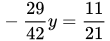
Wir addieren zur ersten Gleichung das
−
5
7
{\displaystyle {}-{\frac {5}{7}}}
-fache der zweiten Gleichung und erhalten
−
29
42
y
=
11
21
{\displaystyle {}-{\frac {29}{42}}y={\frac {11}{21}}\,}
bzw.
y
=
−
22
29
.
{\displaystyle {}y=-{\frac {22}{29}}\,.}
Daher ist
x
=
−
1
15
y
−
1
5
=
1
15
⋅
22
29
−
1
5
=
22
−
87
435
=
−
65
435
=
−
13
87
.
{\displaystyle {}x=-{\frac {1}{15}}y-{\frac {1}{5}}={\frac {1}{15}}\cdot {\frac {22}{29}}-{\frac {1}{5}}={\frac {22-87}{435}}=-{\frac {65}{435}}=-{\frac {13}{87}}\,.}
Wir betrachten im
C
3
{\displaystyle {}{\mathbb {C} }^{3}}
den
Untervektorraum
U
=
⟨
(
1
+
i
3
2
−
i
)
,
(
1
−
i
−
3
i
−
1
−
2
i
)
⟩
.
{\displaystyle {}U=\langle {\begin{pmatrix}1+{\mathrm {i} }\\3\\2-{\mathrm {i} }\end{pmatrix}},\,{\begin{pmatrix}1-{\mathrm {i} }\\-3{\mathrm {i} }\\-1-2{\mathrm {i} }\end{pmatrix}}\rangle \,.}
Bestimme die
Dimension
von
U
{\displaystyle {}U}
.
Lösung
Es ist
(
1
−
i
−
3
i
−
1
−
2
i
)
=
−
i
(
1
+
i
3
2
−
i
)
,
{\displaystyle {}{\begin{pmatrix}1-{\mathrm {i} }\\-3{\mathrm {i} }\\-1-2{\mathrm {i} }\end{pmatrix}}=-{\mathrm {i} }{\begin{pmatrix}1+{\mathrm {i} }\\3\\2-{\mathrm {i} }\end{pmatrix}}\,,}
der zweite Vektor ist also ein Vielfaches des ersten Vektors und damit überflüssig. Daher ist die Dimension gleich
1
{\displaystyle {}1}
.
Wir betrachten die
lineare Abbildung
φ
:
R
2
→
R
2
{\displaystyle {}\varphi \colon \mathbb {R} ^{2}\rightarrow \mathbb {R} ^{2}}
,
die durch die
Matrix
(
8
4
5
9
)
{\displaystyle {}{\begin{pmatrix}8&4\\5&9\end{pmatrix}}}
gegeben ist.
Bestimme das
Bild
der durch die Gleichung
5
x
−
7
y
=
0
{\displaystyle {}5x-7y=0\,}
gegebenen Geraden.
Bestimme das
Urbild
der durch die Gleichung
6
x
−
11
y
=
0
{\displaystyle {}6x-11y=0\,}
gegebenen Geraden.
Lösung
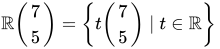
Die Gerade kann man auch als
R
(
7
5
)
=
{
t
(
7
5
)
∣
t
∈
R
}
{\displaystyle {}\mathbb {R} {\begin{pmatrix}7\\5\end{pmatrix}}={\left\{t{\begin{pmatrix}7\\5\end{pmatrix}}\mid t\in \mathbb {R} \right\}}\,}
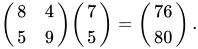
auffassen. Das Bild des erzeugenden Vektors ist
(
8
4
5
9
)
(
7
5
)
=
(
76
80
)
.
{\displaystyle {}{\begin{pmatrix}8&4\\5&9\end{pmatrix}}{\begin{pmatrix}7\\5\end{pmatrix}}={\begin{pmatrix}76\\80\end{pmatrix}}\,.}
Alle Vielfache von
(
7
5
)
{\displaystyle {}{\begin{pmatrix}7\\5\end{pmatrix}}}
werden auf Vielfache von
(
76
80
)
{\displaystyle {}{\begin{pmatrix}76\\80\end{pmatrix}}}
abgebildet, somit ist die Bildgerade gekürzt gleich
R
(
19
20
)
.
{\displaystyle \mathbb {R} {\begin{pmatrix}19\\20\end{pmatrix}}.}
Wir schreiben die Koordinaten des ersten Raumes als
(
x
,
y
)
{\displaystyle {}(x,y)}
und die Koordinaten den zweiten Raumes als
(
u
,
v
)
{\displaystyle {}(u,v)}
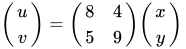
. Aus der Beziehung
(
u
v
)
=
(
8
4
5
9
)
(
x
y
)
{\displaystyle {}{\begin{pmatrix}u\\v\end{pmatrix}}={\begin{pmatrix}8&4\\5&9\end{pmatrix}}{\begin{pmatrix}x\\y\end{pmatrix}}\,}
ergibt sich
6
u
−
11
v
=
6
(
8
x
+
4
y
)
−
11
(
5
x
+
9
y
)
=
−
7
x
−
75
y
.
{\displaystyle {}6u-11v=6(8x+4y)-11(5x+9y)=-7x-75y\,.}
Somit wird die Urbildgerade durch die Gleichung
−
7
x
−
75
y
=
0
{\displaystyle {}-7x-75y=0\,}
beschrieben.
Lösung
Lösung
Es seien
v
=
v
1
,
…
,
v
n
{\displaystyle {}{\mathfrak {v}}=v_{1},\ldots ,v_{n}}
und
w
=
w
1
,
…
,
w
m
{\displaystyle {}{\mathfrak {w}}=w_{1},\ldots ,w_{m}}
Basen von
V
{\displaystyle {}V}
bzw.
W
{\displaystyle {}W}
und es seien
s
1
,
…
,
s
n
{\displaystyle {}s_{1},\ldots ,s_{n}}
die Spaltenvektoren von
M
{\displaystyle {}M}
.
Die Abbildung
φ
{\displaystyle {}\varphi }
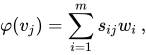
hat die Eigenschaft
φ
(
v
j
)
=
∑
i
=
1
m
s
i
j
w
i
,
{\displaystyle {}\varphi (v_{j})=\sum _{i=1}^{m}s_{ij}w_{i}\,,}
wobei
s
i
j
{\displaystyle {}s_{ij}}
der
i
{\displaystyle {}i}
-te Eintrag des
j
{\displaystyle {}j}
-ten Spaltenvektors
s
j
{\displaystyle {}s_{j}}
ist. Daher ist
φ
(
∑
j
=
1
n
a
j
v
j
)
=
∑
j
=
1
n
a
j
(
∑
i
=
1
m
s
i
j
w
i
)
=
∑
i
=
1
m
(
∑
j
=
1
n
a
j
s
i
j
)
w
i
.
{\displaystyle {}\varphi {\left(\sum _{j=1}^{n}a_{j}v_{j}\right)}=\sum _{j=1}^{n}a_{j}{\left(\sum _{i=1}^{m}s_{ij}w_{i}\right)}=\sum _{i=1}^{m}{\left(\sum _{j=1}^{n}a_{j}s_{ij}\right)}w_{i}\,.}
Dies ist genau dann
0
{\displaystyle {}0}
, wenn
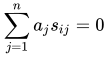
∑
j
=
1
n
a
j
s
i
j
=
0
{\displaystyle {}\sum _{j=1}^{n}a_{j}s_{ij}=0}
für alle
i
{\displaystyle {}i}
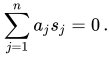
ist, und dies ist äquivalent zu
∑
j
=
1
n
a
j
s
j
=
0
.
{\displaystyle {}\sum _{j=1}^{n}a_{j}s_{j}=0\,.}
Dafür gibt es ein nichttriviales
(Lösungs-)Tupel
(
a
1
,
…
,
a
n
)
{\displaystyle {}{\left(a_{1},\ldots ,a_{n}\right)}}
genau dann, wenn die Spalten linear abhängig sind und genau dann, wenn der
Kern
von
φ
{\displaystyle {}\varphi }
nicht trivial ist. Dies ist gemäß
Lemma 11.4 (Lineare Algebra (Osnabrück 2024-2025))
äquivalent dazu, dass
φ
{\displaystyle {}\varphi }
nicht injektiv ist.
Lösung
Es sei
M
=
(
a
i
j
)
1
≤
i
,
j
≤
n
{\displaystyle {}M={\left(a_{ij}\right)}_{1\leq i,j\leq n}}
mit
a
i
j
=
0
{\displaystyle {}a_{ij}=0\,}
für
i
>
j
{\displaystyle {}i>j}
und sei
M
∘
N
=
E
n
{\displaystyle {}M\circ N=E_{n}\,}
mit
N
=
(
b
i
j
)
1
≤
i
,
j
≤
n
{\displaystyle {}N={\left(b_{ij}\right)}_{1\leq i,j\leq n}}
.
Es ist
a
n
n
≠
0
{\displaystyle {}a_{nn}\neq 0}
,
da sonst die letzte Zeile von
M
{\displaystyle {}M}
die Nullzeile wäre, was im invertierbaren Fall nicht sein kann. Wir betrachten die Produkte der
n
{\displaystyle {}n}
-ten Zeile von
M
{\displaystyle {}M}
mit den Spalten von
N
{\displaystyle {}N}
. Dies führt zu den Bedingungen
a
n
n
⋅
b
n
j
=
0
{\displaystyle {}a_{nn}\cdot b_{nj}=0}
für
j
<
n
{\displaystyle {}j<n}
und daraus folgt
b
n
j
=
0
{\displaystyle {}b_{nj}=0}
für
j
<
n
{\displaystyle {}j<n}
.
Das gleiche Argument, angewendet auf die Untermatrix
(
a
i
j
)
1
≤
i
,
j
≤
n
−
1
{\displaystyle {}{\left(a_{ij}\right)}_{1\leq i,j\leq n-1}}
ergibt Zeile von Zeile das Resultat.
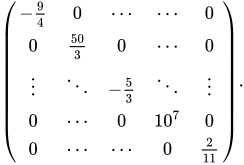
Bestimme die
inverse Matrix
von
(
−
9
4
0
⋯
⋯
0
0
50
3
0
⋯
0
⋮
⋱
−
5
3
⋱
⋮
0
⋯
0
10
7
0
0
⋯
⋯
0
2
11
)
.
{\displaystyle {\begin{pmatrix}-{\frac {9}{4}}&0&\cdots &\cdots &0\\0&{\frac {50}{3}}&0&\cdots &0\\\vdots &\ddots &-{\frac {5}{3}}&\ddots &\vdots \\0&\cdots &0&10^{7}&0\\0&\cdots &\cdots &0&{\frac {2}{11}}\end{pmatrix}}.}
Lösung
Die inverse Matrix ist
(
−
4
9
0
⋯
⋯
0
0
3
50
0
⋯
0
⋮
⋱
−
3
5
⋱
⋮
0
⋯
0
10
−
7
0
0
⋯
⋯
0
11
2
)
.
{\displaystyle {\begin{pmatrix}-{\frac {4}{9}}&0&\cdots &\cdots &0\\0&{\frac {3}{50}}&0&\cdots &0\\\vdots &\ddots &-{\frac {3}{5}}&\ddots &\vdots \\0&\cdots &0&10^{-7}&0\\0&\cdots &\cdots &0&{\frac {11}{2}}\end{pmatrix}}.}
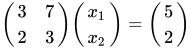
Löse das
lineare Gleichungssystem
(
5
1
−
4
3
)
(
x
1
x
2
)
=
(
3
−
22
)
{\displaystyle {}{\begin{pmatrix}5&1\\-4&3\end{pmatrix}}{\begin{pmatrix}x_{1}\\x_{2}\end{pmatrix}}={\begin{pmatrix}3\\-22\end{pmatrix}}\,}
mit Hilfe der
Cramerschen Regel .
Lösung
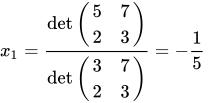
Es ist
x
1
=
det
(
3
1
−
22
3
)
det
(
5
1
−
4
3
)
=
31
19
{\displaystyle {}x_{1}={\frac {\det {\begin{pmatrix}3&1\\-22&3\end{pmatrix}}}{\det {\begin{pmatrix}5&1\\-4&3\end{pmatrix}}}}={\frac {31}{19}}\,}
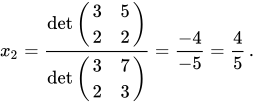
und
x
2
=
det
(
5
3
−
4
−
22
)
det
(
5
1
−
4
3
)
=
−
98
19
=
−
98
19
.
{\displaystyle {}x_{2}={\frac {\det {\begin{pmatrix}5&3\\-4&-22\end{pmatrix}}}{\det {\begin{pmatrix}5&1\\-4&3\end{pmatrix}}}}={\frac {-98}{19}}=-{\frac {98}{19}}\,.}
Beweise die Leibniz-Formel für die Determinante.
Lösung
Wir führen Induktion über
n
≥
1
{\displaystyle {}n\geq 1}
,
wobei der Induktionsanfang klar ist. Es sei also
n
≥
2
{\displaystyle {}n\geq 2}
.
Die Menge der Permutationen
π
∈
S
n
{\displaystyle {}\pi \in S_{n}}
kann man aufspalten, indem man nach
π
(
1
)
=
i
{\displaystyle {}\pi (1)=i}
sortiert und die bijektive Abbildung
π
|
{
2
,
…
,
n
}
:
{
2
,
…
,
n
}
⟶
{
1
,
…
,
n
}
∖
{
i
}
{\displaystyle \pi {|}_{\{2,\ldots ,n\}}\colon \{2,\ldots ,n\}\longrightarrow \{1,\ldots ,n\}\setminus \{i\}}
als eine Permutation
ρ
{\displaystyle {}\rho }
auf
{
1
,
…
,
n
−
1
}
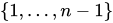
{\displaystyle {}\{1,\ldots ,n-1\}}
auffasst, indem man beide Mengen ordnungstreu mit
{
1
,
…
,
n
−
1
}
{\displaystyle {}\{1,\ldots ,n-1\}}
identifiziert. Dies ergibt eine Bijektion
S
n
,
i
≅
S
n
−
1
{\displaystyle {}S_{n,i}\cong S_{n-1}}
,
wobei hier
S
n
,
i
{\displaystyle {}S_{n,i}}
die Menge der Permutationen auf
{
1
,
…
,
n
}
{\displaystyle {}{\{1,\ldots ,n\}}}
bezeichnet, die
1
{\displaystyle {}1}
auf
i
{\displaystyle {}i}
abbilden. Zwischen den Signa besteht dabei die Beziehung
sgn
(
π
)
=
(
−
1
)
i
−
1
sgn
(
ρ
)
=
(
−
1
)
i
+
1
sgn
(
ρ
)
,
{\displaystyle {}\operatorname {sgn} (\pi )=(-1)^{i-1}\operatorname {sgn} (\rho )=(-1)^{i+1}\operatorname {sgn} (\rho )\,,}
da man
i
−
1
{\displaystyle {}i-1}
Transpositionen braucht, um die
i
{\displaystyle {}i}
-te Stelle und die erste Stelle zu vertauschen. Es besteht also insgesamt eine natürliche Bijektion
S
n
=
⨄
i
∈
{
1
,
…
,
n
}
S
n
,
i
=
⨄
i
∈
{
1
,
…
,
n
}
S
n
−
1
.
{\displaystyle {}S_{n}=\biguplus _{i\in \{1,\ldots ,n\}}S_{n,i}=\biguplus _{i\in \{1,\ldots ,n\}}S_{n-1}\,.}
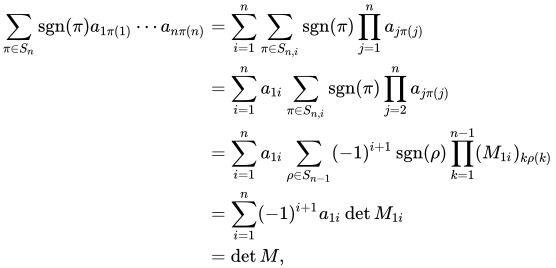
Somit gilt
∑
π
∈
S
n
sgn
(
π
)
a
1
π
(
1
)
⋯
a
n
π
(
n
)
=
∑
i
=
1
n
∑
π
∈
S
n
,
i
sgn
(
π
)
∏
j
=
1
n
a
j
π
(
j
)
=
∑
i
=
1
n
a
1
i
∑
π
∈
S
n
,
i
sgn
(
π
)
∏
j
=
2
n
a
j
π
(
j
)
=
∑
i
=
1
n
a
1
i
∑
ρ
∈
S
n
−
1
(
−
1
)
i
+
1
sgn
(
ρ
)
∏
k
=
1
n
−
1
(
M
1
i
)
k
ρ
(
k
)
=
∑
i
=
1
n
(
−
1
)
i
+
1
a
1
i
det
M
1
i
=
det
M
,
{\displaystyle {}{\begin{aligned}\sum _{\pi \in S_{n}}\operatorname {sgn} (\pi )a_{1\pi (1)}\cdots a_{n\pi (n)}&=\sum _{i=1}^{n}\sum _{\pi \in S_{n,i}}\operatorname {sgn} (\pi )\prod _{j=1}^{n}a_{j\pi (j)}\\&=\sum _{i=1}^{n}a_{1i}\sum _{\pi \in S_{n,i}}\operatorname {sgn} (\pi )\prod _{j=2}^{n}a_{j\pi (j)}\\&=\sum _{i=1}^{n}a_{1i}\sum _{\rho \in S_{n-1}}(-1)^{i+1}\operatorname {sgn} (\rho )\prod _{k=1}^{n-1}(M_{1i})_{k\rho (k)}\\&=\sum _{i=1}^{n}(-1)^{i+1}a_{1i}\det M_{1i}\\&=\det M,\end{aligned}}}
wobei
M
1
i
{\displaystyle {}M_{1i}}
die Streichungsmatrix zur ersten Zeile und
i
{\displaystyle {}i}
-ten Spalte ist
(und sich die Indizierung auf diese Matrix bezieht).
Für die vorletzte Gleichung geht die Induktionsvoraussetzung ein und die letzte Gleichung beruht auf
der Entwicklung der Determinante nach der ersten Zeile .
Lösung
Wenn
P
{\displaystyle {}P}
ein Vielfaches von
X
−
a
{\displaystyle {}X-a}
ist, so kann man
P
=
(
X
−
a
)
Q
{\displaystyle {}P=(X-a)Q\,}
mit einem weiteren Polynom
Q
{\displaystyle {}Q}
schreiben. Einsetzen ergibt
P
(
a
)
=
(
a
−
a
)
Q
(
a
)
=
0
.
{\displaystyle {}P(a)=(a-a)Q(a)=0\,.}
Im Allgemeinen gibt es
aufgrund der Division mit Rest
eine Darstellung
P
=
(
X
−
a
)
Q
+
R
,
{\displaystyle {}P=(X-a)Q+R\,,}
wobei
R
=
0
{\displaystyle {}R=0}
oder aber den Grad
0
{\displaystyle {}0}
besitzt, also so oder so eine Konstante ist. Einsetzen ergibt
P
(
a
)
=
R
.
{\displaystyle {}P(a)=R\,.}
Wenn also
P
(
a
)
=
0
{\displaystyle {}P(a)=0}
ist, so muss der Rest
R
=
0
{\displaystyle {}R=0}
sein, und das bedeutet, dass
P
=
(
X
−
a
)
Q
{\displaystyle {}P=(X-a)Q}
ist.
Lösung
Wir betrachten die reelle Matrix
M
=
(
1
2
0
0
3
4
0
0
0
0
5
6
0
0
7
8
)
.
{\displaystyle {}M={\begin{pmatrix}1&2&0&0\\3&4&0&0\\0&0&5&6\\0&0&7&8\end{pmatrix}}\,.}
a) Bestimme das
charakteristische Polynom
von
M
{\displaystyle {}M}
.
b) Bestimme die
Eigenwerte
von
M
{\displaystyle {}M}
.
c) Bestimme die
Eigenräume
von
M
{\displaystyle {}M}
.
Lösung
a) Das charakteristische Polynom der Blockmatrix
M
{\displaystyle {}M}
mit den Blöcken
A
=
(
1
2
3
4
)
{\displaystyle {}A={\begin{pmatrix}1&2\\3&4\end{pmatrix}}}
und
B
=
(
5
6
7
8
)
{\displaystyle {}B={\begin{pmatrix}5&6\\7&8\end{pmatrix}}}
ist nach
Lemma 23.7 (Lineare Algebra (Osnabrück 2024-2025))
gleich
χ
M
=
χ
A
⋅
χ
B
=
(
(
X
−
1
)
(
X
−
4
)
−
6
)
(
(
X
−
5
)
(
X
−
8
)
−
42
)
=
(
X
2
−
5
X
−
2
)
(
X
2
−
13
X
−
2
)
=
X
4
−
18
X
3
+
61
X
2
+
36
X
+
4.
{\displaystyle {}{\begin{aligned}\chi _{M}&=\chi _{A}\cdot \chi _{B}\\&={\left((X-1)(X-4)-6\right)}{\left((X-5)(X-8)-42\right)}\\&={\left(X^{2}-5X-2\right)}{\left(X^{2}-13X-2\right)}\\&=X^{4}-18X^{3}+61X^{2}+36X+4.\end{aligned}}}
b) Die Eigenwerte von
M
{\displaystyle {}M}
, also nach
Satz 23.2 (Lineare Algebra (Osnabrück 2024-2025))
die Nullstellen des charakteristischen Polynoms, bestimmen wir, indem wir die
p-q-Formel
auf die beiden quadratischen Faktoren anwenden. Dies ergibt die Eigenwerte
x
1
=
25
+
8
+
5
2
=
33
+
5
2
,
{\displaystyle {}x_{1}={\frac {{\sqrt {25+8}}+5}{2}}={\frac {{\sqrt {33}}+5}{2}}\,,}
x
2
=
−
33
+
5
2
,
{\displaystyle {}x_{2}={\frac {-{\sqrt {33}}+5}{2}}\,,}
x
3
=
169
+
8
+
13
2
=
177
+
13
2
,
{\displaystyle {}x_{3}={\frac {{\sqrt {169+8}}+13}{2}}={\frac {{\sqrt {177}}+13}{2}}\,,}
x
4
=
−
177
+
13
2
.
{\displaystyle {}x_{4}={\frac {-{\sqrt {177}}+13}{2}}\,.}
c) Die Eigenwerte verschieden sind, sind die zugehörigen Eigenräume eindimensional. Wir müssen jeweils einen Eigenvektor ausrechnen, was wir für die Blockmatrizen tun. Für
33
+
5
2
(
1
0
0
1
)
−
(
1
2
3
4
)
=
(
33
+
5
2
−
1
−
2
−
3
33
+
5
2
−
4
)
=
(
33
+
3
2
−
2
−
3
33
−
3
2
)
{\displaystyle {}{\frac {{\sqrt {33}}+5}{2}}{\begin{pmatrix}1&0\\0&1\end{pmatrix}}-{\begin{pmatrix}1&2\\3&4\end{pmatrix}}={\begin{pmatrix}{\frac {{\sqrt {33}}+5}{2}}-1&-2\\-3&{\frac {{\sqrt {33}}+5}{2}}-4\end{pmatrix}}={\begin{pmatrix}{\frac {{\sqrt {33}}+3}{2}}&-2\\-3&{\frac {{\sqrt {33}}-3}{2}}\end{pmatrix}}\,}
ist
v
1
=
(
2
33
+
3
2
)
{\displaystyle {}v_{1}={\begin{pmatrix}2\\{\frac {{\sqrt {33}}+3}{2}}\end{pmatrix}}\,}
ein nichttriviales Element des Kerns.
Für
−
33
+
5
2
(
1
0
0
1
)
−
(
1
2
3
4
)
=
(
−
33
+
5
2
−
1
−
2
−
3
−
33
+
5
2
−
4
)
=
(
−
33
+
3
2
−
2
−
3
−
33
−
3
2
)
{\displaystyle {}{\frac {-{\sqrt {33}}+5}{2}}{\begin{pmatrix}1&0\\0&1\end{pmatrix}}-{\begin{pmatrix}1&2\\3&4\end{pmatrix}}={\begin{pmatrix}{\frac {-{\sqrt {33}}+5}{2}}-1&-2\\-3&{\frac {-{\sqrt {33}}+5}{2}}-4\end{pmatrix}}={\begin{pmatrix}{\frac {-{\sqrt {33}}+3}{2}}&-2\\-3&{\frac {-{\sqrt {33}}-3}{2}}\end{pmatrix}}\,}
ist
v
2
=
(
2
−
33
+
3
2
)
{\displaystyle {}v_{2}={\begin{pmatrix}2\\{\frac {-{\sqrt {33}}+3}{2}}\end{pmatrix}}\,}
ein Element des Kerns.
Für
177
+
13
2
(
1
0
0
1
)
−
(
5
6
7
8
)
=
(
177
+
13
2
−
5
−
6
−
7
177
+
13
2
−
8
)
=
(
177
+
3
2
−
6
−
7
177
−
3
2
)
{\displaystyle {}{\frac {{\sqrt {177}}+13}{2}}{\begin{pmatrix}1&0\\0&1\end{pmatrix}}-{\begin{pmatrix}5&6\\7&8\end{pmatrix}}={\begin{pmatrix}{\frac {{\sqrt {177}}+13}{2}}-5&-6\\-7&{\frac {{\sqrt {177}}+13}{2}}-8\end{pmatrix}}={\begin{pmatrix}{\frac {{\sqrt {177}}+3}{2}}&-6\\-7&{\frac {{\sqrt {177}}-3}{2}}\end{pmatrix}}\,}
ist
v
3
=
(
6
177
+
3
2
)
{\displaystyle {}v_{3}={\begin{pmatrix}6\\{\frac {{\sqrt {177}}+3}{2}}\end{pmatrix}}\,}
ein Element des Kerns.
Für
−
177
+
13
2
(
1
0
0
1
)
−
(
5
6
7
8
)
=
(
−
177
+
13
2
−
5
−
6
−
7
−
177
+
13
2
−
8
)
=
(
−
177
+
3
2
−
6
−
7
−
177
−
3
2
)
{\displaystyle {}{\frac {-{\sqrt {177}}+13}{2}}{\begin{pmatrix}1&0\\0&1\end{pmatrix}}-{\begin{pmatrix}5&6\\7&8\end{pmatrix}}={\begin{pmatrix}{\frac {-{\sqrt {177}}+13}{2}}-5&-6\\-7&{\frac {-{\sqrt {177}}+13}{2}}-8\end{pmatrix}}={\begin{pmatrix}{\frac {-{\sqrt {177}}+3}{2}}&-6\\-7&{\frac {-{\sqrt {177}}-3}{2}}\end{pmatrix}}\,}
ist
v
4
=
(
6
−
177
+
3
2
)
{\displaystyle {}v_{4}={\begin{pmatrix}6\\{\frac {-{\sqrt {177}}+3}{2}}\end{pmatrix}}\,}
ein Element des Kerns.
Die Eigenräume zu dn Eigenwerten sind somit
R
(
2
33
+
3
2
0
0
)
,
R
(
2
−
33
+
3
2
0
0
)
,
R
(
0
0
6
177
+
3
2
)
,
R
(
0
0
6
−
177
+
3
2
)
.
{\displaystyle \mathbb {R} {\begin{pmatrix}2\\{\frac {{\sqrt {33}}+3}{2}}\\0\\0\end{pmatrix}},\,\mathbb {R} {\begin{pmatrix}2\\{\frac {-{\sqrt {33}}+3}{2}}\\0\\0\end{pmatrix}},\,\mathbb {R} {\begin{pmatrix}0\\0\\6\\{\frac {{\sqrt {177}}+3}{2}}\end{pmatrix}},\,\mathbb {R} {\begin{pmatrix}0\\0\\6\\{\frac {-{\sqrt {177}}+3}{2}}\end{pmatrix}}.}
Es sei eine
3
×
3
{\displaystyle {}3\times 3}
-
Matrix
der Form
M
=
(
d
a
b
0
d
c
0
0
d
)
{\displaystyle {}M={\begin{pmatrix}d&a&b\\0&d&c\\0&0&d\end{pmatrix}}\,}
mit
a
,
c
≠
0
{\displaystyle {}a,c\neq 0}
gegeben. Wir betrachten die Vektoren
(
a
c
0
0
)
,
(
b
c
0
)
,
(
0
0
1
)
.
{\displaystyle {\begin{pmatrix}ac\\0\\0\end{pmatrix}},\,{\begin{pmatrix}b\\c\\0\end{pmatrix}},\,{\begin{pmatrix}0\\0\\1\end{pmatrix}}.}
a) Begründe, dass diese Vektoren eine Basis des
K
3
{\displaystyle {}K^{3}}
bilden.
b) Es sei
φ
:
K
3
⟶
K
3
{\displaystyle \varphi \colon K^{3}\longrightarrow K^{3}}
die durch
M
{\displaystyle {}M}
bezüglich der Standardbasis gegebene lineare Abbildung. Erstelle die Matrix, die
φ
{\displaystyle {}\varphi }
bezüglich der neuen Basis beschreibt.
Lösung
a) Wegen
a
c
≠
0
{\displaystyle {}ac\neq 0\,}
sind die drei Vektoren in Stufenform mit von
0
{\displaystyle {}0}
verschiedenen Diagonalelementen, deshalb liegt eine Basis vor.
b) Es ist
(
d
a
b
0
d
c
0
0
d
)
(
a
c
0
0
)
=
(
d
a
c
0
0
)
=
d
(
a
c
0
0
)
,
{\displaystyle {}{\begin{pmatrix}d&a&b\\0&d&c\\0&0&d\end{pmatrix}}{\begin{pmatrix}ac\\0\\0\end{pmatrix}}={\begin{pmatrix}dac\\0\\0\end{pmatrix}}=d{\begin{pmatrix}ac\\0\\0\end{pmatrix}}\,,}
(
d
a
b
0
d
c
0
0
d
)
(
b
c
0
)
=
(
d
b
+
a
c
d
c
0
)
=
(
a
c
0
0
)
+
d
(
b
c
0
)
,
{\displaystyle {}{\begin{pmatrix}d&a&b\\0&d&c\\0&0&d\end{pmatrix}}{\begin{pmatrix}b\\c\\0\end{pmatrix}}={\begin{pmatrix}db+ac\\dc\\0\end{pmatrix}}={\begin{pmatrix}ac\\0\\0\end{pmatrix}}+d{\begin{pmatrix}b\\c\\0\end{pmatrix}}\,,}
(
d
a
b
0
d
c
0
0
d
)
(
0
0
1
)
=
(
b
c
d
)
=
(
b
c
0
)
+
d
(
0
0
1
)
.
{\displaystyle {}{\begin{pmatrix}d&a&b\\0&d&c\\0&0&d\end{pmatrix}}{\begin{pmatrix}0\\0\\1\end{pmatrix}}={\begin{pmatrix}b\\c\\d\end{pmatrix}}={\begin{pmatrix}b\\c\\0\end{pmatrix}}+d{\begin{pmatrix}0\\0\\1\end{pmatrix}}\,.}
Bezüglich dieser Basis ist die beschreibende Matrix gleich
(
d
1
0
0
d
1
0
0
d
)
.
{\displaystyle {\begin{pmatrix}d&1&0\\0&d&1\\0&0&d\end{pmatrix}}.}
Lösung